
KDOC Releases and Kearny County
KASPER stands for Kansas Adult Supervised Population Electronic Repository. The official KDOC description says it includes incarcerated people, people under post-incarceration supervision, and discharged people sentenced to the Secretary since 1980, subject to stated limits. That durable scope makes it useful after a state-prison release tied to a Kearny conviction.
Geography must be handled carefully. Conviction County can identify Kearny, but it does not show where the person was imprisoned, where release occurred, or where the person went. Parole Supervision County answers a separate question. Facility applies to inmates. No KDOC institution was verified inside Kearny County.
KASPER does not cover every jail-only event. A person who spent time only in Kearny County Jail may have no KDOC record. A missing match means the public state repository did not return a person under that search. It does not prove release, no custody, or no case.
| Custody event | Correct first source | Why |
|---|---|---|
| Kearny jail release | KCSO and Kansas VINE | County owns its booking and release |
| KDOC prison release | KASPER | State status and movement are recorded |
| Court probation | District court and Court Services | Probation comes from the court |
| Federal sentence | BOP Locator | Federal custody is separate |
Confirm a KDOC Release
A state-prison release has at least two layers. A movement from an institution into parole, conditional release, or postrelease supervision can mark physical release to the community. The KDOC obligation continues. A sentence discharge or maximum sentence date indicates that the KDOC sentence obligation shown has ended.
- Open the official KASPER disclaimer and note its working-day update caution.
- Search by KDOC number when available. Otherwise use name, alias, and advanced identity fields.
- Compare photograph, birth and physical details, conviction county, and case information.
- Read current status, historical location and movement, anticipated date, parole office, and supervision level together.
- When timing matters, confirm the public status with KDOC. Use the court for the sentence order and KCSO only for its own jail event.
KASPER updates each working day, so a same-day movement may not yet appear. Save the access date. Do not crop a future date away from the status that gives it meaning.
The official KASPER search supplies the state offender lookup shown below.
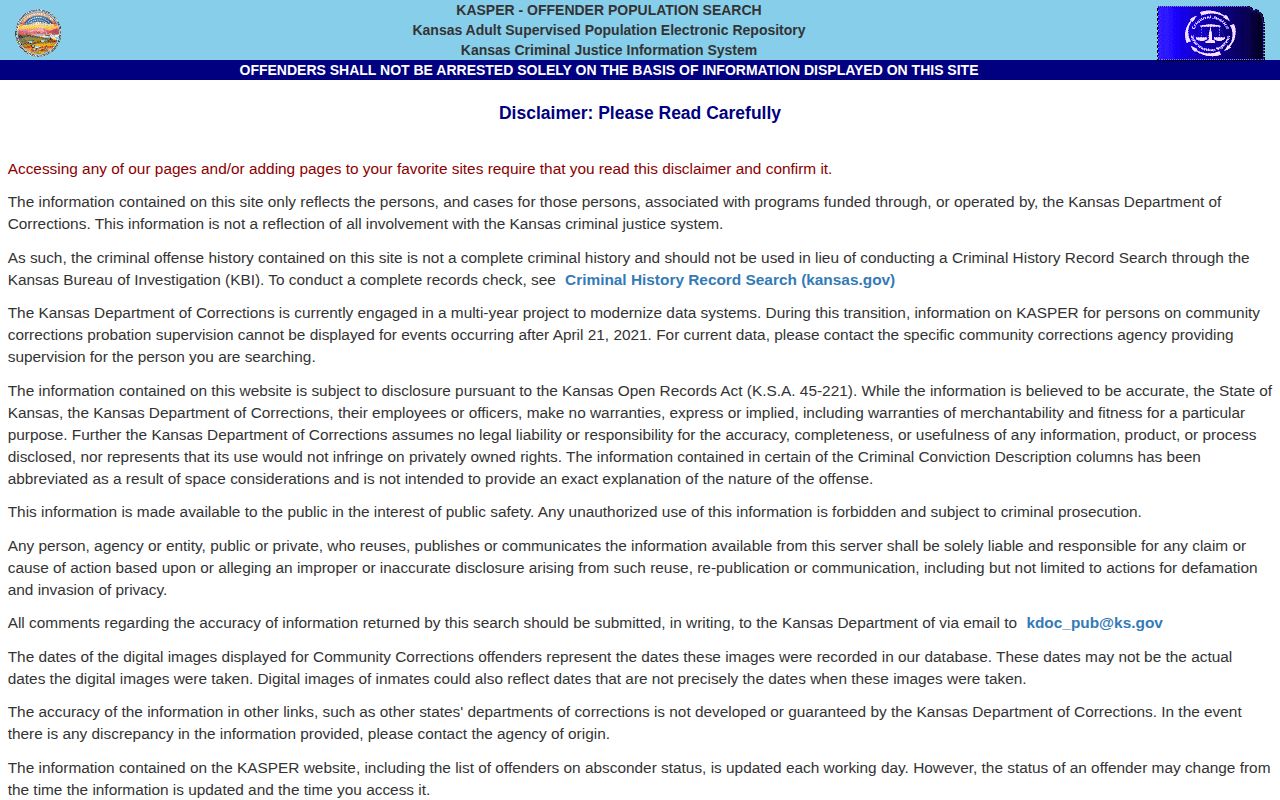
The search form locates candidates; the full detail must establish identity and the nature of the release status.
KASPER Release Record Fields
KASPER supports last, first, and middle name, alias, and KDOC number searches. Advanced options can include KBI number, race, gender, birth date, age range, conviction county, parole-supervision county, and facility for inmates. Photo and thumbnail options can assist identification. There is no released-only filter on the inspected form.
Officially described detail data include name and KDOC number, physical description and photo, conviction, county and case, anticipated release date, locations and movement dates, parole office, custody or supervision level, and disciplinary findings. Each answers a different part of the state-corrections history.
| Field | How to read it |
|---|---|
| Status | Distinguishes incarceration, supervision, and discharge |
| Anticipated release date | Changeable future computation, not proof of exit |
| Movement/location | Helps show transition from institution to community status |
| Parole office | Shows the office maintaining state supervision when listed |
| Conviction county | Case origin, not release destination |
| Sentence discharge | Stronger evidence that the shown KDOC obligation ended |
Compare multiple identifiers. Common names, aliases, and spelling variants can produce mistakes. A photo can help but should not replace case and birth details.
KDOC Anticipated Release Dates
The official Kansas label is “Anticipated release date.” It is a computed date, not a promise. Court-awarded jail credit, sentence start, concurrent or consecutive terms, the controlling sentence, later court corrections, appeals, new sentences, disciplinary forfeiture, and program awards can all affect the result.
K.S.A. 21-6821 allows a maximum 15 percent good-time reduction for many determinate crimes and identifies specified 20 percent categories based on offense severity and date. There is no universal Kansas 85-percent rule. Current law also permits eligible program credits up to 120 days. An older KDOC glossary mentions 60 days, but the current statute controls that conflict.
K.S.A. 22-3717 generally places many post-1993 non-off-grid determinate sentences into mandatory postrelease rather than discretionary parole. Older indeterminate and special cases work differently. An online formula cannot account for all sentence facts, credits, and exclusions.
KDOC’s locating FAQ explains the repository and anticipated-date caveat pictured here.
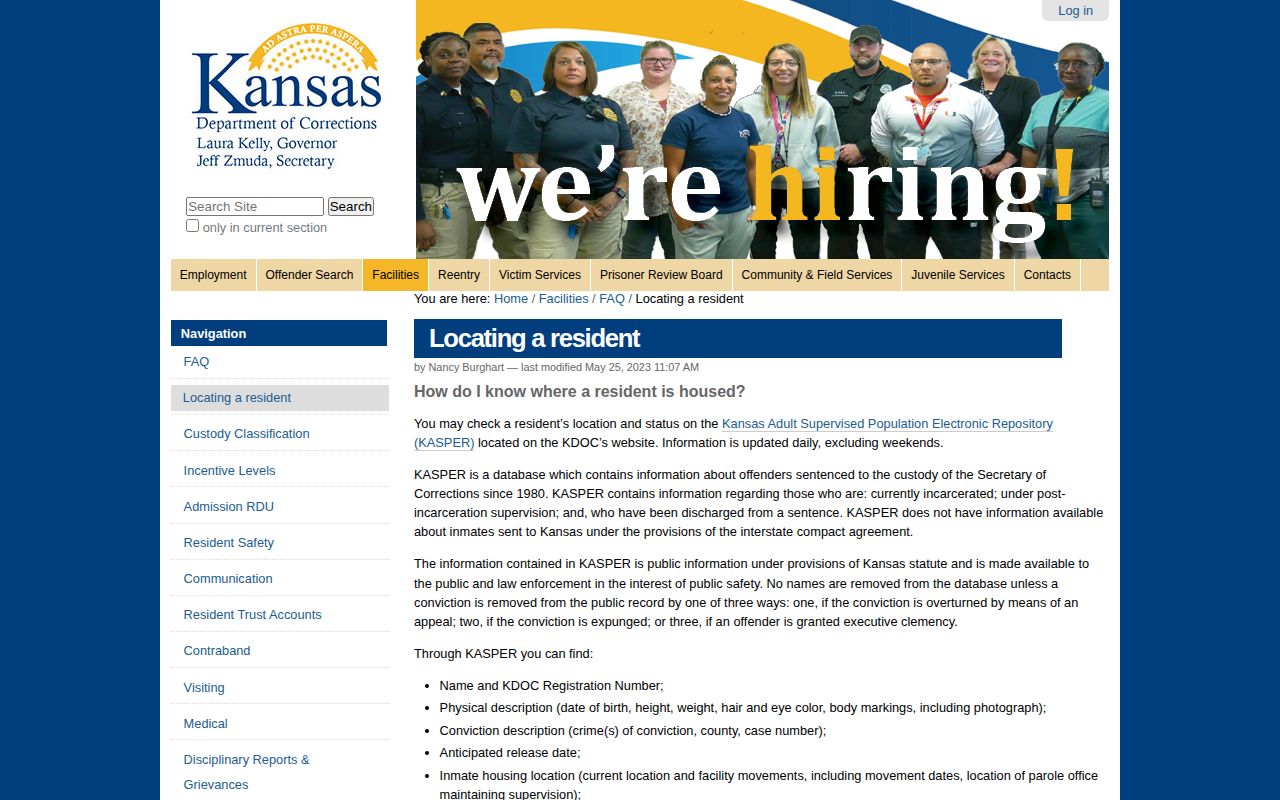
The FAQ supports use of the public label while warning that the displayed date remains subject to change.
KDOC Supervision After Release
Kansas terminology distinguishes parole, conditional release, postrelease supervision, and discharge. Parole is a discretionary release decision for qualifying sentences. Conditional release is tied to a statutory date and retained credit. Postrelease supervision follows the prison portion of many determinate sentences. All three can mean the person lives outside an institution while KDOC control continues.
The KASPER status and parole-office field should be checked together. The Garden City Parole Office, South Region, serves Kearny and surrounding counties at 816 N. Campus Drive, Suite 500, Garden City, Kansas 67846, telephone 620-272-3879. Regional service does not prove a particular person is assigned there, so confirm after matching the public record.
Court probation is separate. The 25th Judicial District Court Services office handles probation across six counties. KASPER warns that newer community-corrections events may not display, so search the court docket and assigned Court Services path for probation. The Kearny County post-release supervision page compares those systems.
- Physical release
- Departure from the prison into community status or another authority’s custody.
- Parole office
- The KDOC field office maintaining a state supervision case.
- Discharge
- End of the sentence obligation shown by the responsible authority.
- Absconder
- An enforcement status alleging loss of required supervision contact, not a release date.
KDOC Records and Corrections
KASPER should be the first KDOC access channel, but it is not the only one. Sentence-date questions go to the KDOC Sentence Computation Unit at 785-296-3317 or KDOCSentCompUnit@doc.ks.gov. Comments about public KASPER data accuracy go to kdoc_pub@ks.gov. Identify the exact field, record, and access date when asking about a discrepancy.
A court owns its sentencing journal entry and later orders. KDOC owns application of those orders to the state computation. KCSO owns its county release event. If records conflict, route the question to the agency with authority over that field rather than demanding that one system rewrite another agency’s record.
KASPER generally retains discharged records, but removal can follow an overturned conviction, expungement, or executive clemency. Interstate-compact information and the repository’s KDOC-program scope also create limits. A person absent from KASPER may still have a court or jail record.
When documentary confirmation beyond the public repository is needed, ask KDOC for an existing record. Do not ask an office to create an individualized calculation for publication. A discharge certificate, official status confirmation, or complete KASPER detail is stronger retrospective evidence than a saved future date.
No Kearny KDOC Prison
No state prison was found within Kearny County. The KDOC entry in the facility map represents a statewide correctional system that can receive a person after transfer from the Kearny County Jail. It should not be described as a local jail, and Garden City supervision offices should not be described as detention facilities.
If KCSO says “transferred to KDOC,” allow time for intake and a working-day repository update. Use the transfer record as the bridge, then compare KDOC number, birth details, conviction county, and case. If KASPER returns no result, check with KCSO for the precise destination rather than guessing.
A Kearny conviction in KASPER does not show that release occurred in Kearny. It also does not prove where the person resides. County labels in state records can refer to conviction or supervision, each with a defined purpose.
KDOC Status Conflict Review
If KASPER, a court order, and a jail transfer entry appear to conflict, compare their roles and timestamps. The court controls its sentence, KDOC controls state computation and movement, and KCSO controls its own departure entry. A court order may precede intake or release processing, while KASPER may update on the next working day.
Preserve the full status context and send a focused correction to the owner of the questioned field. Do not treat an older screenshot as current state custody proof. State when each record was accessed and which event each source actually controls.
KDOC Discharge Record Context
A discharged KASPER record can remain searchable long after a county roster window would close. That makes it useful for a completed state sentence, but the record still reflects KDOC scope. An overturned conviction, expungement, or clemency can remove a public result, and interstate-compact data may be limited.
Use “no public KASPER result found” when a search is blank. Then check the sentencing court and KCSO if the event may have remained jail-only. A discharged state record cannot establish what happened in an unrelated local or federal matter.