
Kearny County Release Date Types
Kansas sources use several dates that sound alike. KDOC's supported public label is Anticipated release date. It is a computation based on the sentence and credits known at the time. The actual release date records physical departure from an institution. A sentence discharge or maximum sentence date marks the end of the identified KDOC obligation. Those events can be months or years apart.
A Kearny County Jail detainee held before trial has no fixed sentence date. Bond may be posted, a court may issue an order, charges may change, or another authority may lodge a hold. A person serving a local sentence has a more definite framework, but KASPER does not calculate it unless KDOC is involved. The sentencing journal entry, jail-credit award, and KCSO release record are the right sources.
| Date or status | Meaning | Limit |
|---|---|---|
| Anticipated release date | KDOC's current computed future date | Can change before release |
| Actual release or movement | Departure from the named custodian | May lead to supervision or transfer |
| Sentence discharge | End of the KDOC obligation shown | Does not resolve unrelated cases |
| Court release order | Legal authority to release | May precede physical processing |
Find Kearny County Prison Dates
KASPER, the Kansas Adult Supervised Population Electronic Repository, is the principal public source for a state-prison date. It covers incarcerated, post-incarceration-supervised, and discharged people associated with KDOC sentences since 1980, subject to stated limits. It is not a Kearny County jail archive. The repository updates on working days and has no released-only filter.
Search fields include last, first, and middle name, alias, KDOC number, and advanced identity and case fields. Conviction County can narrow a search to Kearny. Parole Supervision County answers where supervision is maintained, while Facility applies to inmates. Compare more than a name before reading an anticipated date as the intended person's record.
- Open the official KASPER disclaimer and search entry.
- Use a KDOC number for the most precise search, or try name and alias variants.
- Compare birth details, physical description, photograph, conviction county, and case information.
- Open the full detail. Read status, location and movement, anticipated release date, and parole office together.
- For a date discrepancy, contact the KDOC Sentence Computation Unit rather than calculating a new date.
The KASPER search form is the official source represented below.
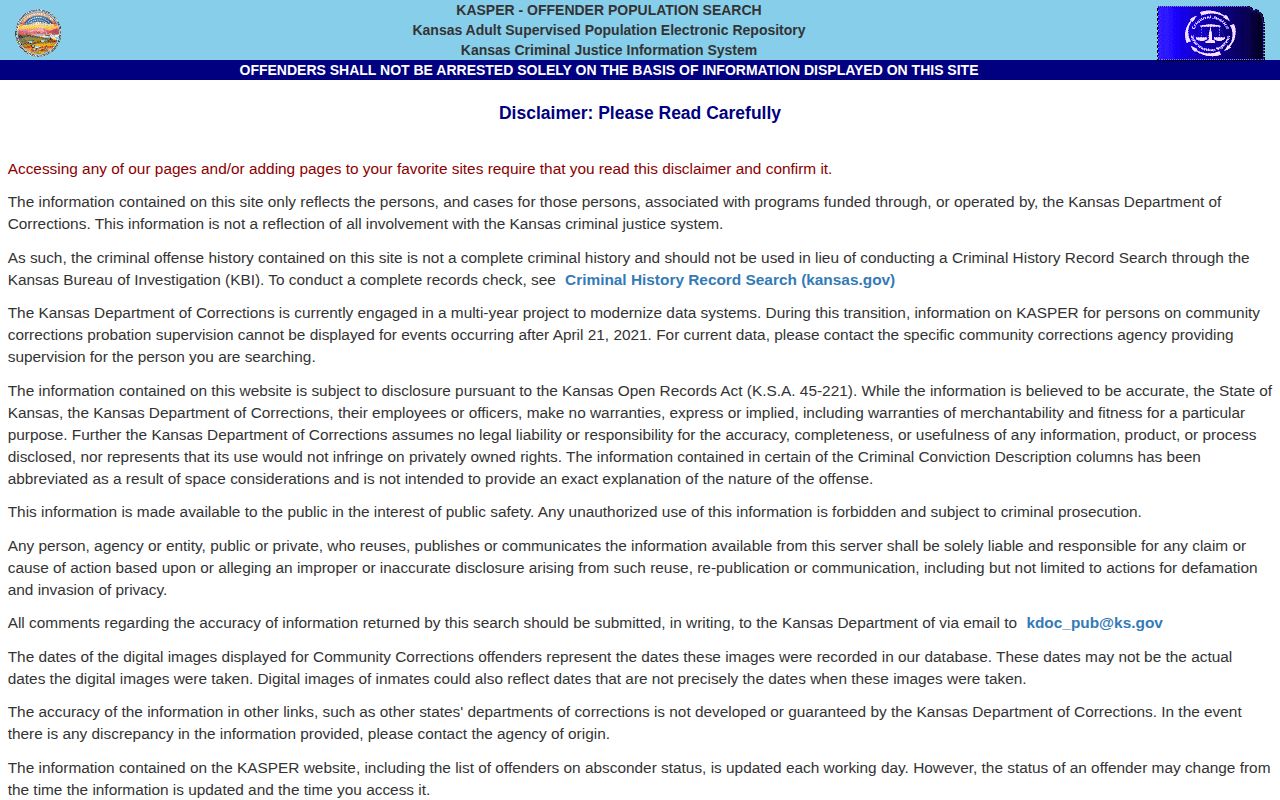
The form helps locate a state record, but only the full detail supplies the status and anticipated date context.
Kearny County Good-Time Rules
K.S.A. 21-6821 is the current primary source for Kansas good time and program credit. It allows a maximum 15 percent good-time reduction for many determinate crimes committed from July 1, 1993. Specified categories based on offense severity and date may have a 20 percent maximum. Kansas therefore does not have one universal statement that every inmate serves 85 percent.
Fifteen percent produces the familiar 85 percent arithmetic only when the person qualifies and earns and retains the maximum credit. An eligible 20 percent category can yield 80 percent. Current law also permits up to 120 days of eligible program credit. The older KDOC glossary refers to a 60-day program-credit cap, but that statement is stale where it conflicts with the current statute.
Credits are not automatic guarantees. Good time and program awards can be earned, withheld, or forfeited under the applicable rules. Offense date, severity level, sentence type, exclusions, and disciplinary history matter. Older indeterminate, off-grid, and special sentences follow distinct provisions. A general percentage should never be applied to an individual date.
Read the current Kansas good-time statute shown in the project capture.
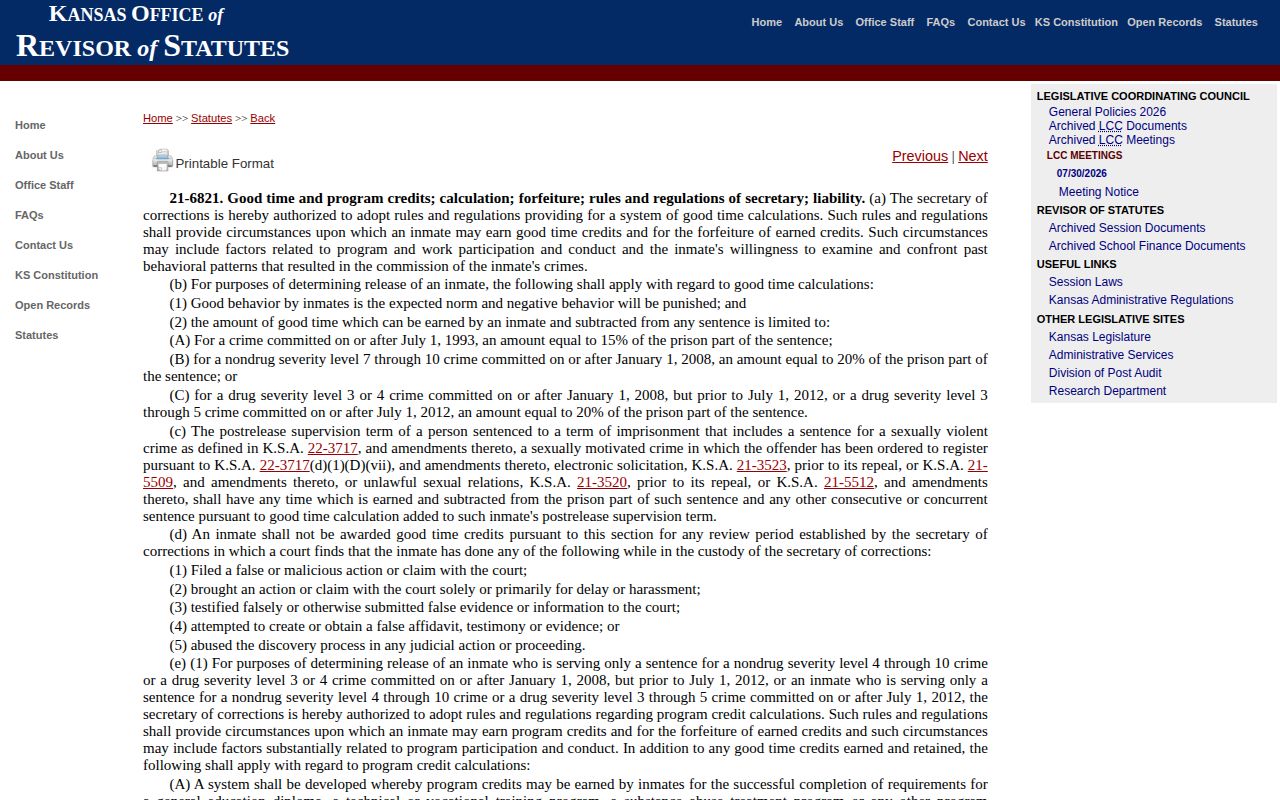
The statute controls current credit limits; the computation unit applies those rules to the actual sentence record.
What Changes Kearny Release Dates
An anticipated release date can move because the inputs change. Court-awarded jail credit can affect the start computation. Concurrent terms run under a different structure from consecutive terms. A later court correction, appeal, new sentence, or controlling-sentence change may alter the calculation. KDOC can also account for credit earned, withheld, restored, or forfeited.
| Factor | Possible effect | Confirm with |
|---|---|---|
| Jail credit or corrected order | Changes time credited or sentence structure | Sentencing court and KDOC |
| Good-time loss | Can move the anticipated date later | KDOC computation record |
| Program credit | May reduce eligible time within the law | KDOC |
| New sentence | May create a new controlling term | Court and KDOC |
| Detainer or hold | May transfer custody after release | Holding and receiving agencies |
| Parole decision | May affect eligible older or special cases | PRB and later KASPER movement |
K.S.A. 22-3717 generally places many post-1993 non-off-grid determinate sentences into mandatory postrelease after the prison portion. Older indeterminate cases can involve parole eligibility based on minimum and maximum terms. A hearing date or favorable board decision still does not prove the day of physical exit.
Note: When sources conflict, KDOC owns the state computation, the court owns its order, and KCSO owns the county jail departure record.
Kearny County Jail Date Requests
Research found no published Kearny County Jail good-time policy, release-time schedule, or weekend and holiday rule. Do not import KDOC prison percentages into a local jail sentence. Obtain the sentencing journal entry, the court's jail-credit award, and the KCSO booking-and-release record. Ask the jail or court to identify the official computation used in that case.
KCSO accepts written Kansas Open Records Act requests. A narrow request can seek the existing booking-and-release record for a named person and date range, including releasable release date and time, authority or type, and receiving agency if transferred. The county brochure states that the agency acts on a request by the end of the third business day, but that means a response, not guaranteed production. Delay, redaction, a cost estimate, or a denial with legal grounds may follow.
106 E. Washington Avenue, PO Box P
Lakin, KS 67860
620-355-6211
Weekdays, 8 a.m. to 5 p.m., excluding holidays
KCSO records request form
A pretrial detainee's date depends on bond and court action, not a sentence calculator. Search the district docket for a bond order, release order, sentencing journal entry, or later modification. If KCSO records a transfer, follow the receiving system. Departure from the county jail is not always release to the community.
Confirm Kearny County Release
Use a retrospective status to confirm that release happened. For KDOC, read a community movement or discharge status with the date, then contact the agency if exact timing matters. For Kearny County Jail, use VINE as a timely event signal and request the KCSO release record for durable proof. For a court-ordered exit, obtain the order and distinguish its legal authorization time from the jail's physical processing time.
VINE covers participating Kansas county jails but expressly excludes KDOC state-prison offenders. A VINE alert can say release, transfer, or escape, which have very different meanings. KASPER is the separate state-prison path. The Kearny County VINE inmate check explains the one-person search and alert workflow.
The KDOC locating FAQ explains that anticipated dates can change and lists the public information commonly shown. Sentence computation questions may go to 785-296-3317 or KDOCSentCompUnit@doc.ks.gov. KASPER data comments go to kdoc_pub@ks.gov.
The official KDOC locating FAQ provides the anticipated-date caveat pictured below.

That guidance reinforces why a live status and agency confirmation are stronger than a saved future date.
Kearny County Date Gaps
A missing public date has several possible causes. The person may have had only a jail case outside KASPER's scope. A court probation event may be absent from KASPER, especially newer community-corrections data affected by modernization. Interstate-compact information can be limited. An overturned or expunged conviction may no longer appear publicly.
Search the correct custodian before drawing a conclusion. KCSO answers for its jail event. KDOC answers for a state sentence. The district court owns the order. BOP, ICE, and USMS require their own federal paths. “No public result found” is accurate; “no record exists” is not supported by a blank portal.
The Kearny County release records overview maps those authorities and explains how a transfer changes the next search. Keep the official label, access date, and source together when recording a result.
Kearny Sentence Evidence Checklist
A sound date check begins with the actual sentence. Obtain the sentencing journal entry and identify whether the term is determinate, indeterminate, off-grid, concurrent, or consecutive. Confirm the jail-credit amount granted by the court. Then compare that source with the KDOC detail or KCSO release record. The same person may have more than one case, so a date tied to one sentence cannot be assumed to resolve every custody basis.
For a state case, keep the offense date and severity level with the statute used. Those facts affect the maximum good-time category. Program credit is separate from good time. Credit that may be earned is not the same as credit already awarded and retained. A conceptual percentage can explain the statute, but it cannot produce an individual release date without the complete official computation.
- Identify the responsible custodian and case number.
- Get the operative sentence and later correction orders.
- Confirm jail credit and sentence structure.
- Read the current official date label with status.
- Ask the computation unit to reconcile any mismatch.
Kearny Parole Date Distinctions
A parole eligibility date is not an anticipated release date. Eligibility means an individual with a qualifying sentence can be considered under the governing law. The Prisoner Review Board can parole, continue, or pass a case. Even a favorable decision can require release-plan steps before physical departure.
The monthly PRB public-comment list is prospective. Its county field refers to conviction county, not residence or release destination. No public person-level decisions database was verified. For a Kearny conviction, use the list only to understand upcoming consideration, then check PRB and later KASPER movement for the actual outcome.
Kearny Release Date Corrections
When the KASPER date differs from the sentencing order, identify whether the conflict concerns the court’s sentence or KDOC’s computation. The court owns its journal entry, jail-credit award, and later correction orders. KDOC owns its application of those records, credit history, controlling sentence, and public anticipated date. Send KASPER accuracy comments to kdoc_pub@ks.gov and sentence questions to the Sentence Computation Unit.
Preserve the complete public detail, not just the date. Include status, movement, KDOC number, case, and access date in a focused question. A date can change after a court correction, appeal, new sentence, disciplinary forfeiture, or program award. An old screenshot can document what was displayed then, but it does not override a current official record.
If a KCSO release entry differs from a court order, the order may have authorized release before physical processing. Ask each office about the field it controls. A reasoned comparison is stronger than choosing the earliest timestamp.