
Federal Releases and Kearny County
No BOP institution was verified in Kearny County. The Federal Bureau of Prisons appears in the local facility map as a separate national custody system, not as a local building. Geography alone is not a reason to use BOP. Start there only when the person was convicted and committed to BOP custody.
The official BOP Locator covers federal inmates from 1982 forward. It can display a location of “RELEASED,” a past release date with no current facility, or a future projected date. BOP explains that a released location means the person is no longer in BOP custody. That conclusion is deliberately narrow.
A person leaving Kearny County Jail for a federal matter may first be in U.S. Marshals Service custody. USMS handles federal prisoners from court commitment through acquittal, a release order, or delivery to BOP. A federal defendant released before BOP commitment may never appear in the BOP Locator. The federal docket is then the primary public path.
| Federal stage | First source | Release evidence |
|---|---|---|
| Pretrial or court detention | Federal docket / USMS | Bond or release order and docket entry |
| Sentenced BOP custody | BOP Locator | RELEASED location or past release date |
| After BOP release | Federal docket / U.S. Probation | Supervised-release status and later orders |
| Immigration transfer | ICE ODLS | ICE custody or recent release result |
Confirm a Federal BOP Release
Use a federal register number whenever it is known. That reduces same-name risk. A name search can use optional age, race, and sex fields, but each match still needs careful comparison against the federal case. The locator result and BOP’s records explanation should travel together.
- Open the official BOP Inmate Locator.
- Search by BOP, FBI, INS, or DCDC number when available. Otherwise search the full name with supported details.
- Compare the result to the federal docket and known identity facts.
- Read the location and release-date fields together. A future date is projected; “RELEASED” or a past date can show departure from BOP.
- Open the official explanation to confirm what the result can and cannot establish, then check another system if transfer or supervision is indicated.
The Kearny County release-system overview helps select KCSO, KDOC, BOP, or ICE when the custody trail changes.
BOP Released Record Meaning
BOP’s official records explanation is essential because the locator uses a compact result. A past release date with no institution can indicate departure on that date. “RELEASED” in the location field means the person is no longer in BOP custody. Neither statement says why the person left or what legal status followed.
Federal supervised release can begin after prison. U.S. Probation monitors that court-ordered term, and the federal docket may contain modifications, violations, revocations, or completion information. A detainer can also transfer the person directly to a state, local, or immigration authority. The receiving agency then owns the next custody record.
The BOP released-record explanation is the source captured below.
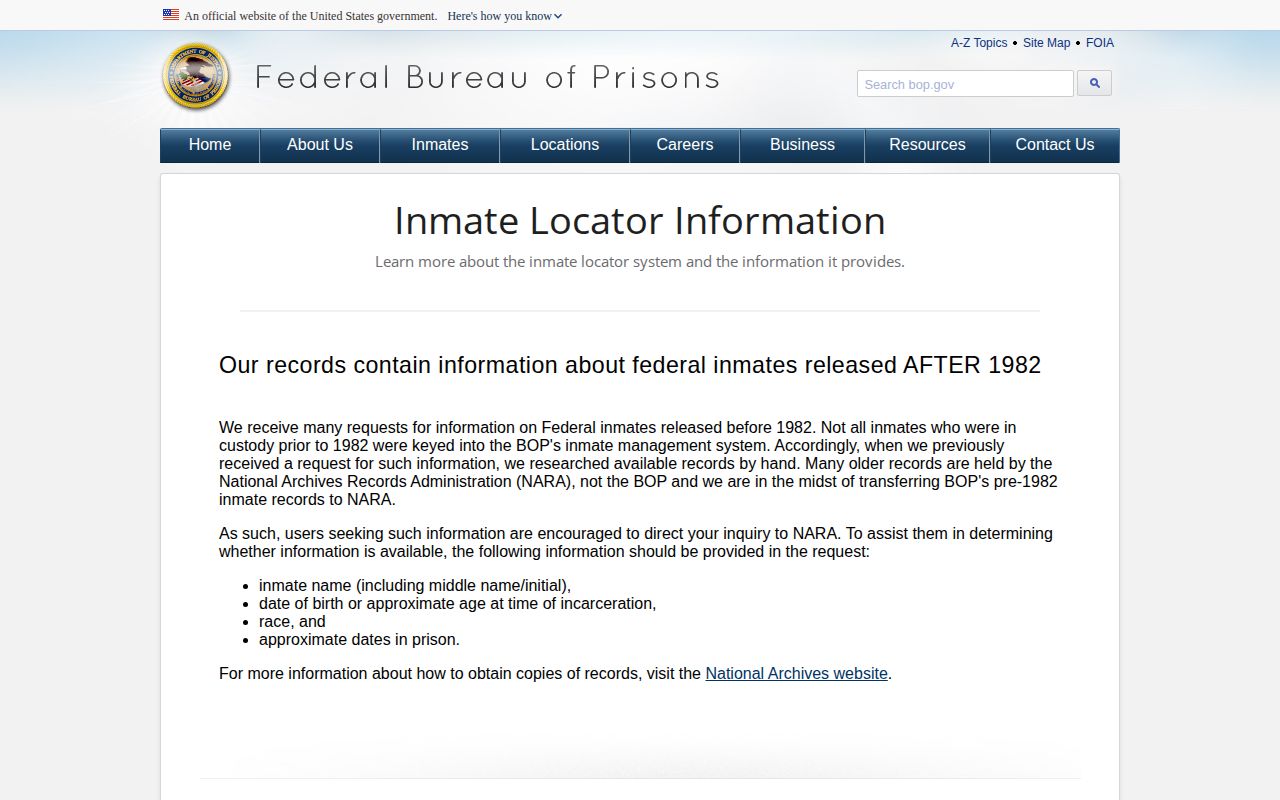
The official explanation keeps a BOP result from being overstated as proof that every form of custody or supervision ended.
- Release date
- The date shown by BOP for departure from its custody, subject to record context.
- Projected date
- A future calculation that can change before actual release.
- Supervised release
- A court-ordered federal community supervision term after prison.
- Detainer
- A request or legal basis for another authority to assume custody.
Federal Release Dates Can Change
A future BOP date is a projection. Federal sentence credits, recalculation, court orders, appeals, program decisions, disciplinary action, and later sentences can affect timing. The locator should not be used to recreate an individual sentence calculation. When the federal court enters a corrected judgment, BOP applies the operative record.
The actual release may lead to a halfway-house or community-corrections phase, supervised release, or another custodian. The locator’s compact display may not describe each transition in the language a family expects. Check the docket for the judgment and later orders, and use the responsible agency for current status.
| Result | Safe conclusion | Next check |
|---|---|---|
| Future date | Projected BOP date | Recheck BOP and docket |
| RELEASED | No longer in BOP custody | Docket, U.S. Probation, or receiving authority |
| No match | No public BOP result under that search | Identifiers, USMS stage, court, ICE, state/local sources |
| Current facility | Still shown in BOP custody | BOP facility and public record |
Note: Do not convert a projected date into a statement that release occurred, even when that date has already passed without a fresh status check.
Kearny Federal Transfer Trail
If KCSO says the person was released to a federal authority, ask which one and record the receiving agency. “Federal hold” is too broad. USMS usually handles federal pretrial and court detention. BOP generally handles sentenced imprisonment. ICE handles civil immigration custody. Each has a distinct public access path.
The KCSO booking-and-release record is the bridge out of county custody. It may show the receiving agency or release authority. Once the destination is established, compare the federal case number, register number, full name, and date range. A same-name BOP result without that bridge can be coincidence.
No standing federal facility or transfer arrangement was verified in Kearny County. Do not name a destination based only on proximity. A person arrested locally can be held elsewhere, and the physical jail may not own the federal court record.
USMS Release Record Route
The U.S. Marshals Service has no public inmate or release locator comparable to BOP. Its Prisoner Tracking System is internal and restricted. Search the federal court docket for detention, bond, release, judgment, and commitment entries. PACER is the main federal court access system, although fees and account rules may apply.
If the public docket does not answer a narrow records question, use the official USMS Freedom of Information Act process. Provide full identifiers, the court and case, and a date range. Request an existing record rather than asking the agency to create an analysis. Expect privacy exemptions and redaction.
USMS policy restricts public release of prisoner histories, photographs, and arrival or departure timing. Do not promise those items. A court release order can show legal authority, while an agency record may be needed to establish actual physical departure.
Federal Result Verification
Preserve the official result, explanation, and access date. A locator screen without its field definitions can be misread. If the result conflicts with a court order, remember that an order may authorize release before physical processing, while a locator update may follow later.
Route corrections by authority. BOP owns its custody record. The federal court owns its docket and orders. KCSO owns the local departure entry. ICE owns immigration custody. Describe what each source says instead of merging them into a broader claim.
A blank BOP search can reflect spelling, a different identifier, pre-1982 records, federal pretrial status, or custody outside BOP. It cannot prove that the person was released. Recheck the federal docket and the system indicated by the transfer trail.
BOP Identity and Record Limits
A federal register number is stronger than a name-only search. When only a name is known, compare age, race, sex, case location, and dates with the federal docket. Do not select a result solely because Kearny County appears elsewhere in the person’s history. The BOP system is national, and common names can return more than one candidate.
BOP coverage begins in 1982. An absent result can reflect the time period as well as the custody stage. A federal defendant held by USMS before sentencing is outside the normal sentenced-prison path. Someone released on a federal court order before BOP commitment may have no BOP record to find.
When a result is found, preserve the location field, release date, register number, and access date with the official explanation. Those details allow another reader to reproduce the authority-specific conclusion without turning it into a claim about every form of custody.
After Federal Prison Release
The judgment can impose supervised release after incarceration. U.S. Probation, not BOP, manages that community phase under the court’s authority. Later docket entries can concern modifications, violations, revocation, or termination. A BOP released result should therefore lead to the judgment when the question is whether a federal sentence still has active terms.
A transfer can also follow BOP departure. If the facts point to an ICE detainer, use ODLS. If they point to a Kansas warrant or sentence, use the responsible state or local agency. The date one authority released the person does not establish when the next authority did so.
BOP Record Corrections
If a locator result conflicts with the federal docket, save the register number, displayed location, release date, and access date. BOP owns its custody fields, while the court owns the judgment and release orders. A docket correction does not automatically update the locator at once.
Describe the conflict narrowly and contact the authority responsible for that field. Do not use a local jail record to rewrite a BOP event or a BOP result to reinterpret an ICE transfer.