
Kearny County VINE Coverage
Kearny County publishes a dedicated VINE program page directing users to VINELink, VINEMobile, and 1-866-574-8463. The system supports custody information and notifications by phone, email, SMS, TTY, and app where offered. It is a victim-information and notification service fed by participating agencies, not a permanent county release archive.
The Kansas Attorney General's VINE material states that the Kansas program covers adult offenders in participating county jails and excludes KDOC state-prison offenders. A person leaving Kearny County Jail for a KDOC institution may generate a county custody change, but the next state record belongs in KASPER. A jail-only booking may never appear in KASPER.
- Release
- The participating jail reports that its custody ended, subject to direct confirmation.
- Transfer
- The person left one facility or authority but remains in custody elsewhere.
- Discharge
- A corrections term indicating that the sentence or supervision obligation ended, not merely that prison custody ended.
Search Kearny VINE Records
Use the official Kansas VINELink person search. A common name can return more than one result. Compare the available facility and identifier details before opening or registering on a record.
- Select Kansas in the official state instance. Avoid treating a general web result as the live record.
- Enter the person's name or identifier. Try known spelling or name variants if the first search is blank.
- Review each possible match. Compare the listed agency, facility, age or other non-sensitive identifiers that the interface provides.
- Open the correct record and read the custody status and event label. Record the access time because agency data can change.
- If no Kearny jail result appears, confirm with KCSO. Then use the Kearny County release search paths for court, KDOC, federal, or immigration custody.
A missing match is not proof of release. The name may differ, data may lag, the person may be held for another county, or the person may have entered a system that Kansas VINE does not cover.
Kearny VINE Result Fields
The live interface controls the precise labels. Read the record as a set, and never crop a status away from the agency or time context.
| Item | How to read it |
|---|---|
| Name and identifier | Helps distinguish people with similar names. |
| Agency or facility | Identifies the participating custodian supplying the event. |
| Custody status | Indicates the current reported state in that agency's data. |
| Event type | Separates release, transfer, escape, or another reported change. |
| Notification options | Shows which channels can be registered for that record. |
VINE is not the source for a KDOC “Anticipated release date.” That label appears in KASPER for applicable state cases and describes a future computation that may change. Federal BOP and ICE records also require their own official locators.
The captured Kansas state search screen shows the official entry point:
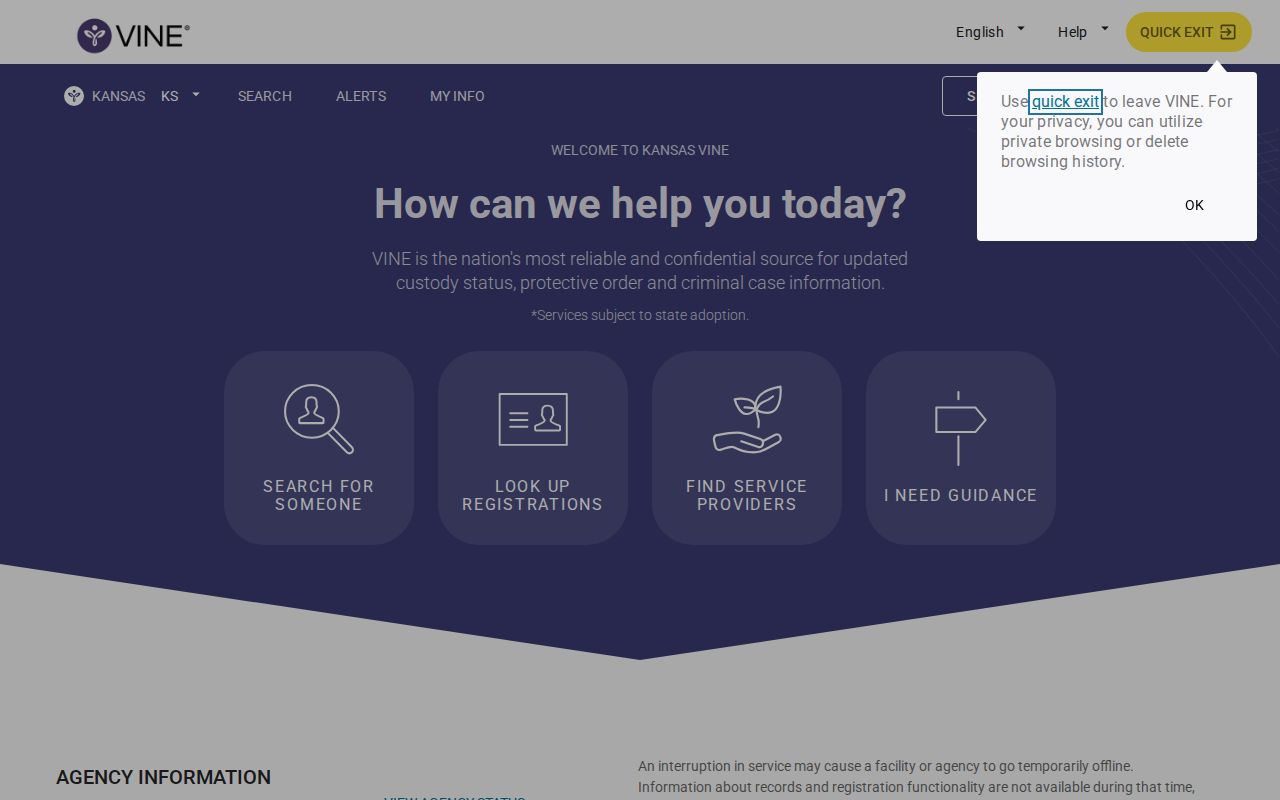
The state branding and search controls help distinguish this source from unofficial lookalike pages.
Register Kearny Release Alerts
Registration works best while the correct in-custody record is open. Choose the channel offered for that record and keep any confirmation details private.
- Select notification registration from the correct person's record.
- Choose phone, email, text, or an in-app option when the current interface offers it.
- For phone registration, create a four-digit PIN. The PIN comes from the user, not the inmate or jail.
- When an automated call arrives, listen to the message and enter the PIN followed by the pound key to acknowledge it.
- If the PIN is forgotten, call 1-866-574-8463 and use the help option. Email registration does not use a PIN.
Unanswered or unacknowledged calls may repeat for up to 24 hours under the Kansas instructions. Save the time and event wording. Then contact the named facility to confirm whether the event was release to the community or movement to another custodian.
Confirm Kearny VINE Alerts
Kansas warns users not to rely on VINE alone. It is available around the clock, but the record starts with data from a participating agency. Transmission delays or entry errors can occur. For an urgent Kearny custody question, call KCSO and state the event type and alert time.
For a KDOC transfer, accept the KASPER disclaimer, then search by name, alias, or KDOC number. Compare status, movements, dates, and parole-office fields. KASPER updates on working days and has no released-only filter.
For Kearny jail documentary proof, request the existing booking-and-release record from KCSO. Ask for the release date and time, authority or type, and destination or receiving agency. A court release order can explain legal authority, while the jail record is stronger for physical departure.
Kearny VINE Notification Layer
The county's own VINE page is the local bridge to the statewide service. It confirms that Kearny directs users to the system and lists telephone and digital channels. VINEMobile is not a sheriff roster, booking-photo gallery, or independent county release feed.
A VINE transfer alert should send the search forward. Ask KCSO for the destination. If KDOC accepted the person, wait for intake and use KASPER. If another county jail accepted custody, check that jail's VINE participation or records route. If the notice says release, obtain KCSO confirmation when the distinction matters.
Alerts serve timely personal notice, but a saved official release record or court order is better for later court or records work. Preserve only the details needed to identify the event.
Kearny Registry Cross-Check
The KBI offender registry is a separate system. It may show a current photo and statutory public fields only when a registration duty independently applies. A registry match does not establish when Kearny custody ended, and a blank result does not establish release.
Use a registry result only as a cross-check. Pair it with the actual jail, KDOC, federal, or court source that documents the custody event.
Read Kearny VINE Events
A notification is useful only when its event type is preserved. “Release” reports that the participating agency's custody ended. “Transfer” directs the user to another custodian. “Escape” is an urgent custody event and must never be paraphrased as release. The record or message may use other status wording, so retain the exact official label when asking KCSO to confirm it.
Transfer is especially important in Kearny County. The local jail has limited capacity and may board detainees, while a person can also move into KDOC, federal, or immigration custody. Ask for the receiving agency. If another county jail accepted custody, use that jail's VINE or records channel. If KDOC accepted the person, KASPER becomes the relevant repository after intake.
A VINE alert does not explain the court's legal reason. The Kearny criminal case may contain a bond order, release order, sentencing entry, revocation, or disposition. Use the court record for that explanation and the jail record for the physical custody event.
Verify Kearny VINE Matches
Identity checks matter when names are common or spelling has changed. Compare at least two non-sensitive identifiers when the interface supplies them. Useful points include the facility, age or birth information, offender identifier, and known booking context. Never choose a result solely because the name looks close.
If several records could match, call the participating agency rather than registering blindly. Give the full name and another known identifier. Ask which public record or official field distinguishes the correct custody episode. Avoid collecting or repeating addresses, victim details, medical facts, juvenile information, or other protected material.
A blank result also needs care. Search common spelling and alias variants, confirm that Kansas was selected, and ask whether the person is held for another county. The event may be outside VINE's retention or coverage. “No public VINE match found” is accurate. “The person was released” is not supported by a blank result.
Kearny VINE Versus KASPER
VINE and KASPER answer different custody questions. Kansas VINE covers adult offenders in participating county jails. KASPER is the Kansas Adult Supervised Population Electronic Repository for KDOC-associated incarceration, post-incarceration supervision, and discharge. Neither is a universal Kansas criminal-history search.
| Question | VINE | KASPER |
|---|---|---|
| Brief Kearny jail booking | Primary notification source when participating data is present | May have no record at all |
| Transfer into state prison | May report the county custody change | Becomes relevant after KDOC intake |
| Future prison release date | Not the KDOC date source | May show “Anticipated release date” |
| State supervision or discharge | Outside Kansas county-only scope | May show status, movement, and parole office |
KASPER updates each working day and warns that information can change. It has no released-only filter. Community-corrections events after April 21, 2021 may be absent due to system modernization. A blank KASPER record does not cure a blank VINE result.
Use Kearny Alerts Safely
Keep the four-digit phone PIN private and choose a number that can receive repeated automated calls. Entering the PIN and pound key acknowledges the message. If a shared phone could expose a sensitive notification, use an available email or other channel that better fits the user's needs.
VINE warns against sole reliance because agency data can lag or contain error. Preserve the message time, then call the named facility. For an urgent safety concern, use the appropriate emergency or law-enforcement channel rather than waiting for a web refresh. For ordinary records work, ask KCSO for documentary confirmation.
Notification registration does not grant access to protected supervision details or court documents. It also does not establish that all sentence obligations ended. A person released from jail may remain on probation, parole, postrelease supervision, or another authority's hold.
Correct Kearny VINE Conflicts
When VINE conflicts with a jail statement, identify the exact alert, timestamp, person, and event label to KCSO. KCSO owns its release or transfer record. If a later KASPER entry conflicts about state status, direct that issue to KDOC rather than asking the sheriff to revise the state repository.
Preserve the official URL and enough context to show what the interface displayed. Do not save unrelated names or identifiers from search results. A useful correction record states the original display, the authority that supplied the correction, and the time the correction was confirmed.
Public Record Search
Sponsored Results